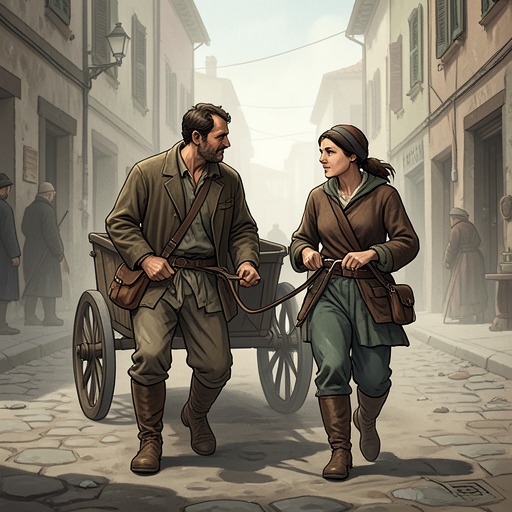
Jerry Barker and Polly as Husband and Wife
Black BeautyJerry Barker and Polly Barker as Husband and Wife are shown through the ordinary actions of a shared household: welcoming one another home, caring for their children and horses, and making decisions together. Their marriage helps define the warmth of Jerry’s home, a place where Black Beauty is greeted as a creature to be befriended rather than merely a cab horse to be put to work. The relationship also sits within the pressures of cab driving, though the evidence distinguishes Polly’s domestic care from Jerry’s direct responsibility for earning a living and managing the horses.
Household and Family Life
When Jerry brings Black Beauty home, Polly and the children come out to meet him. The greeting is lively, and the family gathers around the horse in their small stable-yard. Polly offers to prepare a bran mash while Jerry rubs Black Beauty down; their division of care is practical and immediate, with food and grooming both attended to. The horse is led into a clean, comfortable stall with dry straw and receives supper. His first impression of the household is hopeful: the welcome extends beyond Jerry to the family as a whole.
Polly and Jerry’s children, Harry Barker and Dolly Barker, are part of the household’s affectionate atmosphere. The narration describes the family as unusually fond of one another and merry together. Polly’s kindness toward Black Beauty is expressed in small, concrete gestures: she visits with Dolly the next morning, brings him a slice of apple, and speaks to him gently. Dolly brings bread and pets him without fear. These actions give the horse a chance to respond in kind, and he tries to show that he wishes to be friendly. Their welcome makes his entry into the family’s life feel like a renewed experience of being treated with tenderness.
Shared Decisions and Care for Black Beauty
Jerry’s manner toward Black Beauty is attentive to the horse’s comfort. When fitting the cab harness, he takes pains to ensure the collar and bridle sit properly; after the crupper is loosened by a hole or two, the equipment fits. The care is compared with the considerate attention Black Beauty had known from John Manly. Polly’s part is not to manage the harness, but her welcome and kindness belong to the same household setting in which Jerry takes that care seriously.
The couple’s clearest joint decision concerns the horse’s name. Polly observes that nobody can establish whose fault it was that Black Beauty has injured knees. Jerry therefore chooses to give him the benefit of the doubt, valuing his firm, neat step, and proposes the name Jack, after a previous horse. Polly agrees because she likes to keep a good name going. The exchange is brief, but it shows them making room for the horse’s unknown past without treating his injuries as proof against him. Jerry supplies the reasoning; Polly endorses the choice, turning an individual judgment into a shared act of welcome.
Work, Limits, and the Cab-Horse Household
Jerry owns his cab and two horses, and drives and attends to them himself. Polly’s family life is therefore connected to the work that brings the cab and its horses into the yard, although the book gives Jerry, rather than Polly, the responsibility for driving and managing the animals. The distinction matters: their household’s warmth does not erase the labor on which Jerry’s livelihood depends, but Black Beauty’s account contrasts Jerry’s care with the treatment horses receive under less responsible arrangements.
Jerry’s six-days’ cab licence sets a concrete limit on that work. When a gentleman asks him to take Mrs. Briggs regularly to church on Sunday mornings, Jerry declines because his licence does not permit him to carry a fare that day. The gentleman offers to arrange a change and make sure Jerry does not lose money, but the scene establishes Jerry’s stated reason for refusing the Sunday fare. It does not give Polly’s view of the request; its relevance to their marriage lies in the working life around which their household is organized and in the boundary Jerry observes in his own employment.
The contrast becomes sharper in Black Beauty’s later account of cab work under Nicholas Skinner. There, horses receive no Sunday rest, and the men who drive them are also under pressure. Earlier, Jerry had been described as having an interest in treating his own horses well and not overworking them, while Black Beauty recalls the rest and bran mash given in Jerry’s stable. Polly is not named as the author of those working practices, so the contrast should not be attributed to her. Instead, the family scenes establish the humane domestic setting in which Jerry’s more considerate care of his horses takes place.
Significance of the Relationship
The marriage is drawn less through declarations than through coordinated acts: Polly prepares food, Jerry tends the horse, the children join the welcome, and the couple agree on a name that acknowledges Black Beauty’s uncertain history without condemning him. Their home gives the horse a brief return to companionship and kind treatment after changes of ownership. As the surrounding cab episodes expose how economic pressure can reach both drivers and horses, the Barkers’ household offers a specific counterexample: Jerry’s work is still work, but the horse is personally known, attended to, and welcomed into family life.